
*****************************************************************************************************************************************************************
BR Shunting Locomotives - Class 08
*****************************************************************************************************************************************************************
Developed from the 1944 LMS / EE design, these 0-6-0 diesel electric shunting
*****************************************************************************************************************************************************************
Hornby Class 08 Compensated Conversion -
by Pete Johnson
*****************************************************************************************************************************************************************
locomotives were built at various BR works from 1952 onwards.
 D3036 at Wibdenshaw, with sisters D4040 and D3918 in the background en-route to works.
 By the mid-1950s, BR Derby Works was getting into its stride with the build of what was to
become the BR Class 08. The 41st example of the type left the works early in 1954 carrying
steam-era running number ‘13040’.
By the mid-1950s, BR Derby Works was getting into its stride with the build of what was to
become the BR Class 08. The 41st example of the type left the works early in 1954 carrying
steam-era running number ‘13040’.
 Later becoming D3040, and then just 3040 in a post-1968 works visit that would see it
through to TOPS re-numbering as 08 028. This is the condition in which it is modelled to
complete the sequence of Class 08 liveries which suit the 1960 to 1979 operating span of Canada Street.
Later becoming D3040, and then just 3040 in a post-1968 works visit that would see it
through to TOPS re-numbering as 08 028. This is the condition in which it is modelled to
complete the sequence of Class 08 liveries which suit the 1960 to 1979 operating span of Canada Street.
 The early model Class 08 became one of those projects I couldn’t put down, and was completed
sooner than expected. The model has been finished as 13076, in a typical livery for the
close of the 1950s (Hornby model).
The early model Class 08 became one of those projects I couldn’t put down, and was completed
sooner than expected. The model has been finished as 13076, in a typical livery for the
close of the 1950s (Hornby model).
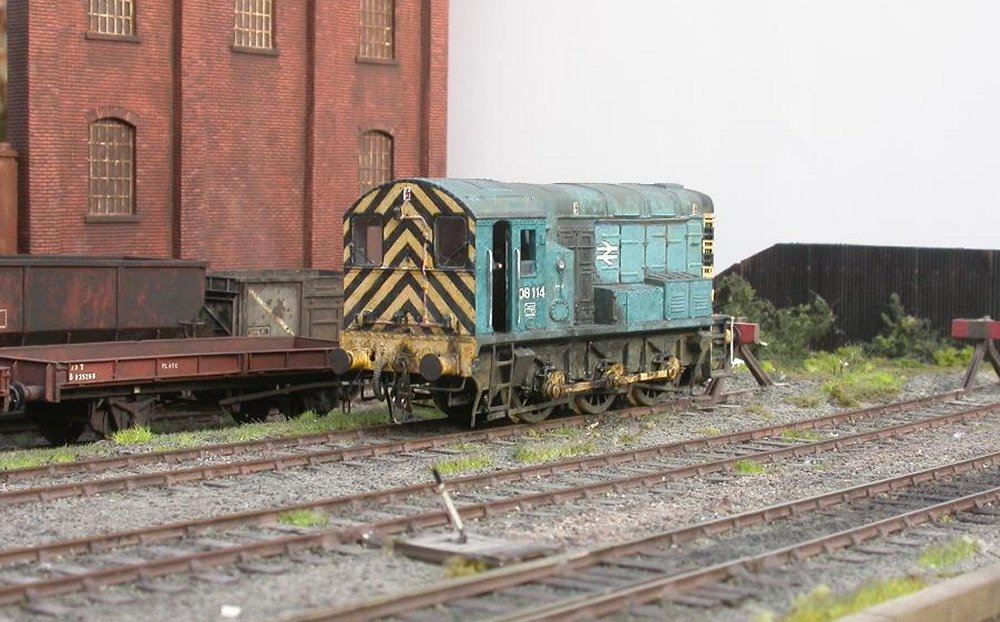 Class 08 number 08114 (3180) at Canada Road, a Modified Lima model.
 Another view of 08114 at Canada Road.
 BR class 08 number 08135 (3203) had spent many years on the ScR, but in truth only
received its TOPS number after moving south to Ebbw Junction during 1974.
BR class 08 number 08135 (3203) had spent many years on the ScR, but in truth only
received its TOPS number after moving south to Ebbw Junction during 1974.
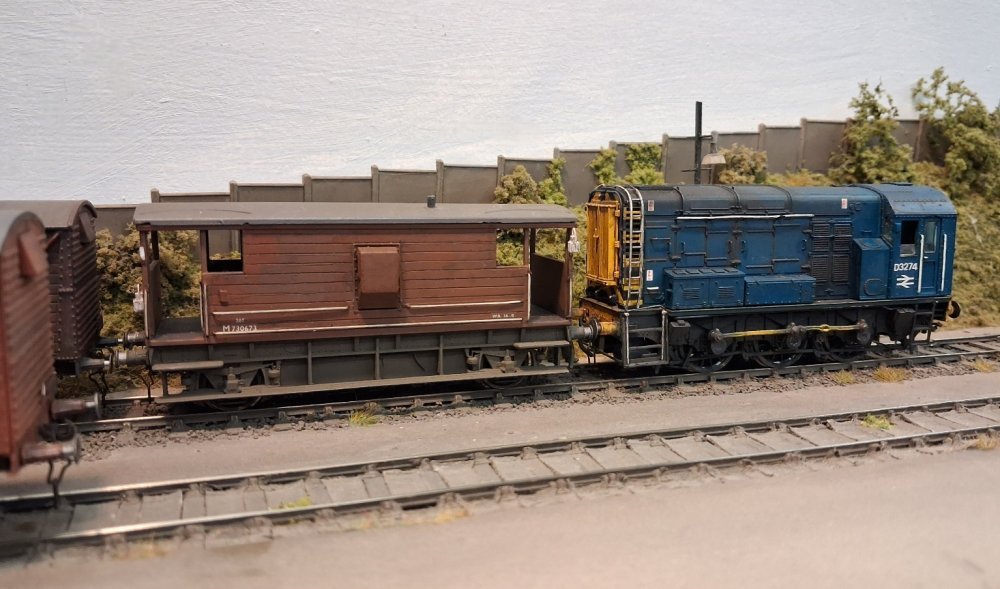 Class 08 D3274 is seen here at Sheepcroft, in a early version of rail blue with number
and arrow on cab side (Hornby model).
Class 08 D3274 is seen here at Sheepcroft, in a early version of rail blue with number
and arrow on cab side (Hornby model).
 Hornby Class 08 for Hartburn by Ian Manderson - 08212 (3282).
 BR class 08 number D3298 - Canada Street.
 In ex-works condition, 3306 is seen in a freight service (minus rods) at Shenston
Road on the way to its new depot (Bachmann).
In ex-works condition, 3306 is seen in a freight service (minus rods) at Shenston
Road on the way to its new depot (Bachmann).
 Black liveried D3311 at Easington Lane (Hornby).
 Class 08 D3316. This example of the class had been repainted into blue, but this time more
fully in line with the new BR corporate image. Most early 08 repaints into blue had the badge
on the cabside, before a shift to the bonnet side position for repaints of a year or two later.
In contrast to the non-standard shunter types, D3316 went on to enjoy a 26 year useful life with BR.
Class 08 D3316. This example of the class had been repainted into blue, but this time more
fully in line with the new BR corporate image. Most early 08 repaints into blue had the badge
on the cabside, before a shift to the bonnet side position for repaints of a year or two later.
In contrast to the non-standard shunter types, D3316 went on to enjoy a 26 year useful life with BR.
 Hornby 08296 (3366) is pictured on an air-braked van at Canada Street.
 BR class 08 number D3381 at Canada Street.
 3690 is a dual braked Class 08 as allocated to Finsbury Park in the early 1970s, captured
here at Hornsey Road depot (modified Hornby).
3690 is a dual braked Class 08 as allocated to Finsbury Park in the early 1970s, captured
here at Hornsey Road depot (modified Hornby).
 Here we can see the completed pair of shunters during a loco swap at Morfa Bank, with 3746
soon to trundle off to Margam depot for refuelling. In real life this shunter was
re-allocated to Cardiff from February 1972, after closure of Port Talbot docks at the
end of 1971, but in my world it never moved and swapped the dock duties for yard pilot
at Morfa Bank, remaining allocated to Margam. By contrast 3432 was a long-term Margam
hump yard pilot and remained there all its life, retaining original green until at least 1973.
Here we can see the completed pair of shunters during a loco swap at Morfa Bank, with 3746
soon to trundle off to Margam depot for refuelling. In real life this shunter was
re-allocated to Cardiff from February 1972, after closure of Port Talbot docks at the
end of 1971, but in my world it never moved and swapped the dock duties for yard pilot
at Morfa Bank, remaining allocated to Margam. By contrast 3432 was a long-term Margam
hump yard pilot and remained there all its life, retaining original green until at least 1973.
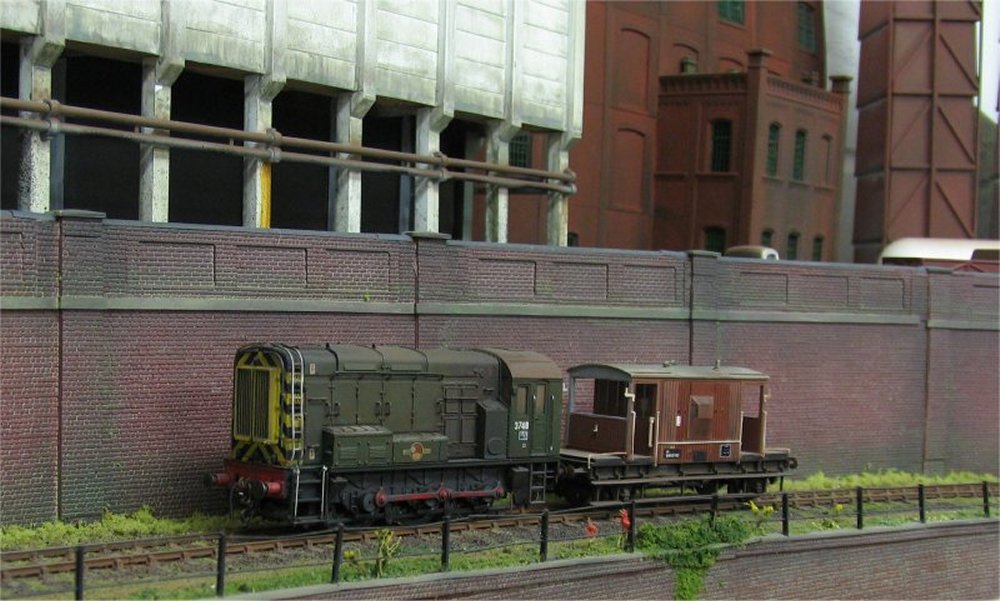 Bachmann Class 08 number 3748 at Shenston Road Gas Works.
 D3918 is joined by D4040, both en-route to works minus rods (Bachmann).
 Canada Street - Hornby Class 08 08767 (3935) is shown after application of the basic livery.
 08767, finished to a very typical 1970s appearance for the class.
 Canada Street's D3988 is weathered to a typical early 1960s appearance and is a solid
performer in several of the show sequences.
Canada Street's D3988 is weathered to a typical early 1960s appearance and is a solid
performer in several of the show sequences.
 D4119 is joined by 4118 and 3748 at Shenston Road stabling point (All Bachmann).
 Worcester allocated D4120 & D4118 are seen at BSC Shenston Works exchange sidings.
 08918 (4148) at Canada Street (Hornby).
 In the Shenston Road TOPS fleet is 08951 (4181) captured at rest in the stabling
sidings just north of the station (Bachmann model).
In the Shenston Road TOPS fleet is 08951 (4181) captured at rest in the stabling
sidings just north of the station (Bachmann model).
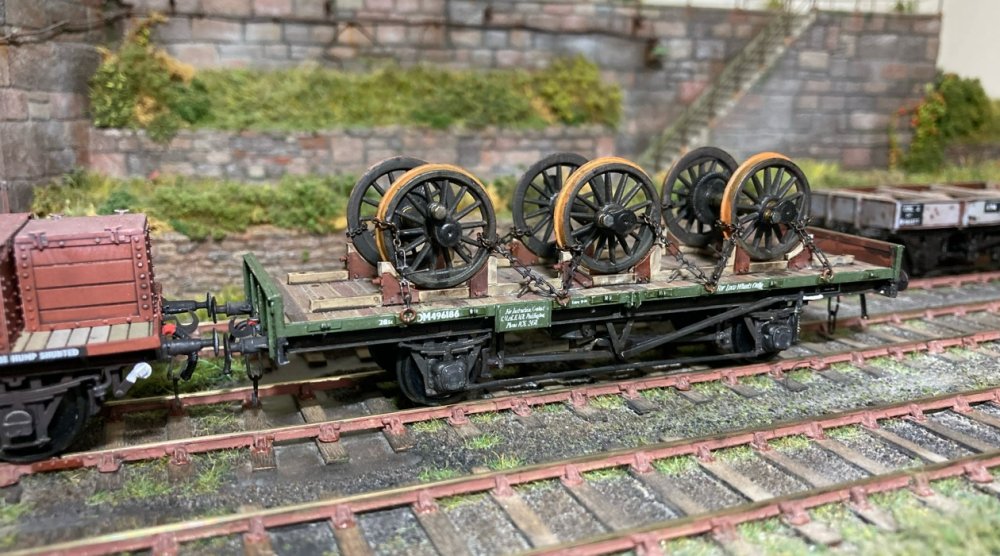 Class 08 wheelsets working back to Swindon via a circuitous route from Cardiff having
arrived at Morfa Bank on the 9O86 Penarth Curve Sidings to Morfa Bank Tip spoil working.
It will head back to Margam Yard on the local trip before joining the 6B62 Margam to
Swindon freight. The load should most probably be sheeted but having spent so long on
the detailing I didn’t want to cover it all up with a big tarpaulin so these are probably
unserviceable wheelsets heading back to Swindon for overhaul!
Class 08 wheelsets working back to Swindon via a circuitous route from Cardiff having
arrived at Morfa Bank on the 9O86 Penarth Curve Sidings to Morfa Bank Tip spoil working.
It will head back to Margam Yard on the local trip before joining the 6B62 Margam to
Swindon freight. The load should most probably be sheeted but having spent so long on
the detailing I didn’t want to cover it all up with a big tarpaulin so these are probably
unserviceable wheelsets heading back to Swindon for overhaul!
 The following sequence of pictures are in response to a visitor to the York show who wanted
more details of how I had added some compensation to the Hornby 08 model. The two springs to be used
(6mm long, 2.4mm diameter, 0.20mm wire) are pictured in front of the chassis block.
The following sequence of pictures are in response to a visitor to the York show who wanted
more details of how I had added some compensation to the Hornby 08 model. The two springs to be used
(6mm long, 2.4mm diameter, 0.20mm wire) are pictured in front of the chassis block.
 I use a hand-drill to create two spring sockets at the non-driven axles. Piloting the holes
at around 1.5mm, and then opening out to 2.5/2.6.
I use a hand-drill to create two spring sockets at the non-driven axles. Piloting the holes
at around 1.5mm, and then opening out to 2.5/2.6.
 A close-up view of one of the finished sockets. They are about 4 to 4.5mm deep, leaving enough
spring action to give downforce to the axle, but not so much as to stop the axles riding on the up
stops on a level surface. To drill the middle axle socket the pick-up strips have to be carefully
lifted up out of the way.
A close-up view of one of the finished sockets. They are about 4 to 4.5mm deep, leaving enough
spring action to give downforce to the axle, but not so much as to stop the axles riding on the up
stops on a level surface. To drill the middle axle socket the pick-up strips have to be carefully
lifted up out of the way.
 The pick-up strips have to be thinned across the middle axle to allow the axle bushes to
move downwards. For this I use a slitting disc on a minidrill. The insulating plastic beneath
still needs to be trimmed to match (using a sharp knife) when I took this view.
The pick-up strips have to be thinned across the middle axle to allow the axle bushes to
move downwards. For this I use a slitting disc on a minidrill. The insulating plastic beneath
still needs to be trimmed to match (using a sharp knife) when I took this view.
 The plastic cover plate also needs to be adapted to allow downward movement of the two
axles. Clearance slots for the four bushes have been drilled and filed to shape.
The plastic cover plate also needs to be adapted to allow downward movement of the two
axles. Clearance slots for the four bushes have been drilled and filed to shape.
 …and the raised edge has been filed flush in a half moon shape in four places.
 With these changes made, the wheelsets – Gibsons on this loco - can be fitted (once the footplate
moulding is back in position). I also skim the faces the moulded hornblocks for the centre axle
on the outside frame moulding before re-fitting to assist side-to-side movement of the EM wheelset.
With these changes made, the wheelsets – Gibsons on this loco - can be fitted (once the footplate
moulding is back in position). I also skim the faces the moulded hornblocks for the centre axle
on the outside frame moulding before re-fitting to assist side-to-side movement of the EM wheelset.
 A view showing the lifted position of the re-fitted axles caused by the added springs. It is
important to ensure that all the brass axle bushes are able to slide freely in the cast slots so
that the low spring force is always able to move the axles downwards.
A view showing the lifted position of the re-fitted axles caused by the added springs. It is
important to ensure that all the brass axle bushes are able to slide freely in the cast slots so
that the low spring force is always able to move the axles downwards.
 With the cover plate refitted the slots allow the bushes enough downward movement to
let the wheelsets follow any uneven trackwork.
With the cover plate refitted the slots allow the bushes enough downward movement to
let the wheelsets follow any uneven trackwork.
 The proof of the pudding! With the rigid driving axle lifted on a 1mm plastic block the
two sprung axles remain in contact with the surface. Maybe not true compensation, but I
certainly believe it assists good running over baseboard joints and suchlike.
The proof of the pudding! With the rigid driving axle lifted on a 1mm plastic block the
two sprung axles remain in contact with the surface. Maybe not true compensation, but I
certainly believe it assists good running over baseboard joints and suchlike.